

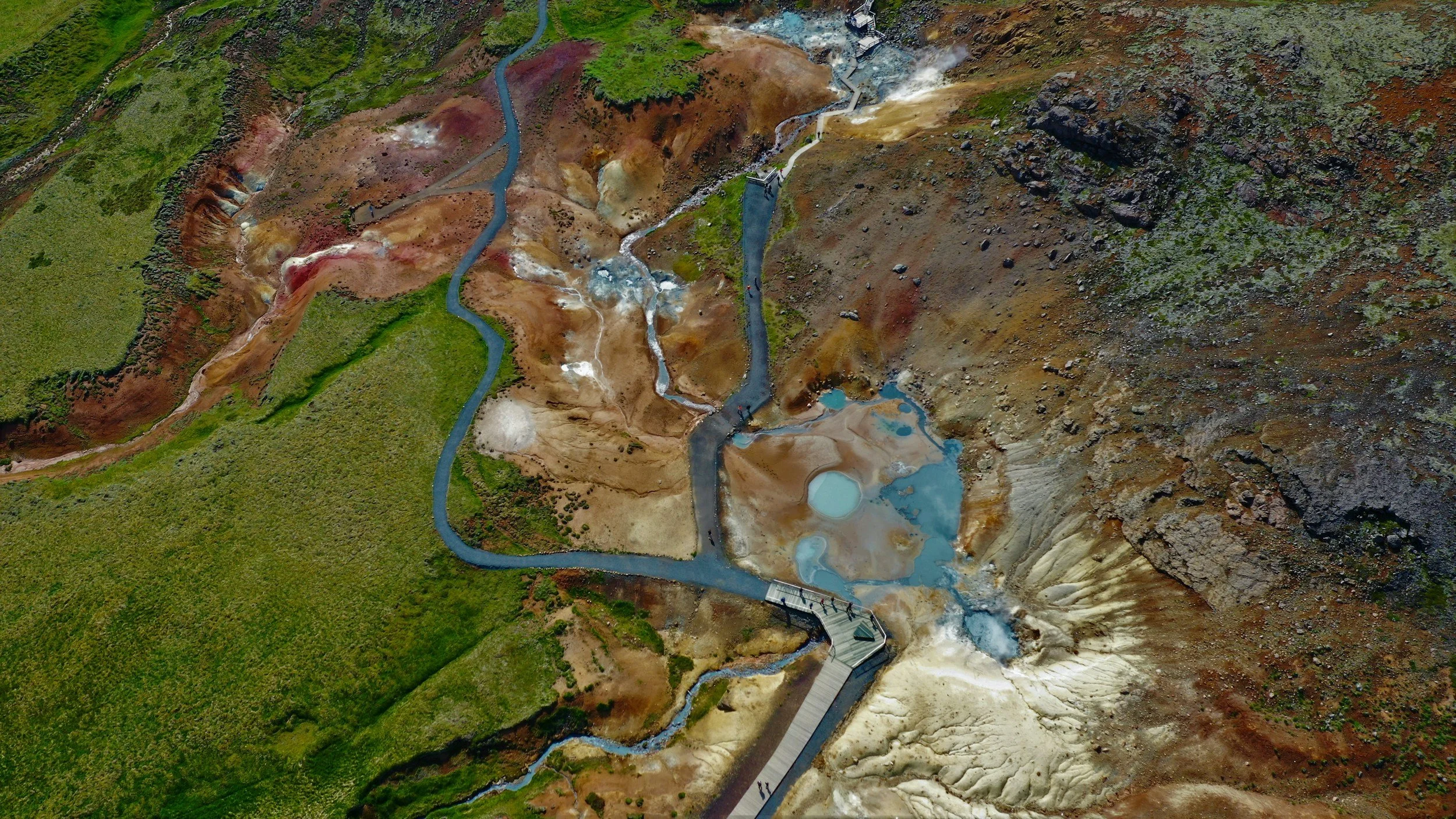
Twenty years reading the earth taught me one thing about transformation.
It is never a breakdown. It is always a formation.
I didn't set out to become a midlife wellness coach.
I set out to survive my own midlife transition.
What happened in between changed everything I thought I knew about the body, about transformation, and about what it actually means to navigate unfamiliar terrain.
The Recognition
Before I tell you my story, I want to tell you something I notice about the women who find their way here.
They are not women who give up easily. They are not women who lack discipline or intelligence or the capacity to figure things out. They are, almost without exception, exceptionally capable — the kind of capable that other people rely on, that careers are built on, that families and teams and communities organize themselves around.
And they are exhausted in a way that has nothing to do with not trying hard enough.
They have tried. They have researched and optimized and pushed through and held it together. They have applied the same rigor to their own wellbeing that they apply to everything else in their professional and personal lives. And something is still not working — not because they are doing it wrong, but because the tools they have always used were not designed for the terrain they are now standing in.
If that is you — if you are the woman who has always known what to do and is standing in completely unfamiliar territory for the first time — then you are in exactly the right place.
And I am, perhaps, exactly the right guide.
Let me tell you why.
Who I Am
I am a geologist.
Not a former geologist. Not a geologist turned wellness coach who left her old life behind to pursue her passion. I am an actively working geologist — still showing up to my corporate role, still reading rock formations and subsurface data, still navigating the particular demands of a technical, evidence-based, predominantly male professional environment.
I am also a certified wellness coach, a certified nutrition coach, a certified sleep, stress management, and recovery specialist, and a yoga teacher.
I hold these two identities — the scientist and the wellness practitioner — not as a contradiction but as a conversation.
They inform each other in ways I could not have anticipated and cannot imagine being without.
And I am a woman in midlife, navigating my own transition from the inside of a full, demanding, professional life.
I am not writing to you from the other side of all of this, with a tidy narrative and a resolved ending. I am writing to you from the middle of it — which is, I have come to believe, exactly where the most useful perspective lives.
I did what I always do when I encounter a problem I don't understand.
I researched. I pursued certifications — in women's wellness, in nutrition, in sleep and stress management, in the embodied intelligence of movement and breath — not to build a business, but for my own development. I needed to understand what was happening in my own body, and I was not willing to settle for surface-level answers. At the time, coaching was not even a consideration. I was simply a scientist doing what scientists do: investigating what she didn't yet understand.
The certifications helped. The research helped. The science gave me a language for some of what I was experiencing, and that language was genuinely valuable.
But it didn't touch the deeper thing.
The deeper thing was this: I was undergoing a transformation that no protocol could navigate. I was not just changing hormonally — I was changing fundamentally. The woman I was becoming was not a modified version of the woman I had been. She was something new. And the process of becoming her was disorienting in a way that no symptom checklist had ever prepared me for.
Here is what happened.
I had spent more than twenty years building expertise in a world that required me to be rigorous, precise, and perpetually competent. I was good at it. I understood the language of evidence, the discipline of systematic thinking, the particular satisfaction of making sense of complex systems.
What I did not anticipate was that my own body would one day become the most complex system I had ever encountered — and that all of my professional tools would be entirely insufficient to read it.
Perimenopause arrived the way it often does for women like us. Not dramatically. Not in a way anyone around me could see. Quietly, persistently, and with a kind of relentlessness that my usual approach of pushing through simply could not touch.
The sleep that used to restore me stopped doing its job. The mind that had been my most reliable professional asset started operating through a kind of static I had no framework for. Emotions arrived without invitation and departed on their own schedule. And beneath all of it, something subtler and more unsettling: I stopped recognizing myself.
Not in a crisis way. In a quieter, more persistent way. The woman I had been — the one who knew what to do, who could be counted on, who held it together — she was still showing up to work, still meeting her commitments, still performing capability with considerable polish.
And she was also, privately and exhaustingly, completely lost.
The shift came, as many of my most important insights have, from geology.
I was recalling a particular metamorphic cross-section — the kind of formation that only occurs under conditions of profound heat and pressure, where the original material is subjected to forces so intense that its entire mineral structure reorganizes. What emerges is not a damaged version of what it was before. It is something denser, more complex, more enduring. Something that could not have existed without the pressure.
And I thought: this is what's happening to me.
Not a breakdown. A reorganization. Not the end of something. The metamorphic process — uncomfortable, disorienting, and producing something I could not yet fully see, but producing something nonetheless.
That reframe did not solve everything. But it changed the quality of my relationship with what I was moving through. It gave me a map when I had been navigating without one.
And it planted the seed of what would eventually become the Elemental Framework™.
The decision to coach came later.
It arrived not as a plan but as a recognition — the slow, accumulating realization that what I had built for myself was exactly what other women needed and could not find. Not a protocol. Not a symptom management system. Not a program that treated midlife transition as a problem to be solved rather than a terrain to be navigated.
Something that held both the science and the soul. That could speak the language of evidence and also make room for what can be felt and sensed and known in the body. That offered orientation rather than instruction — a map, not a prescription.
I built Elemental Wellness Studio because I could not find what I needed when I needed it.
And then I realized I had built what you need.
Want to understand which element is most active in your transition right now?
Start with the Elemental Assessment.
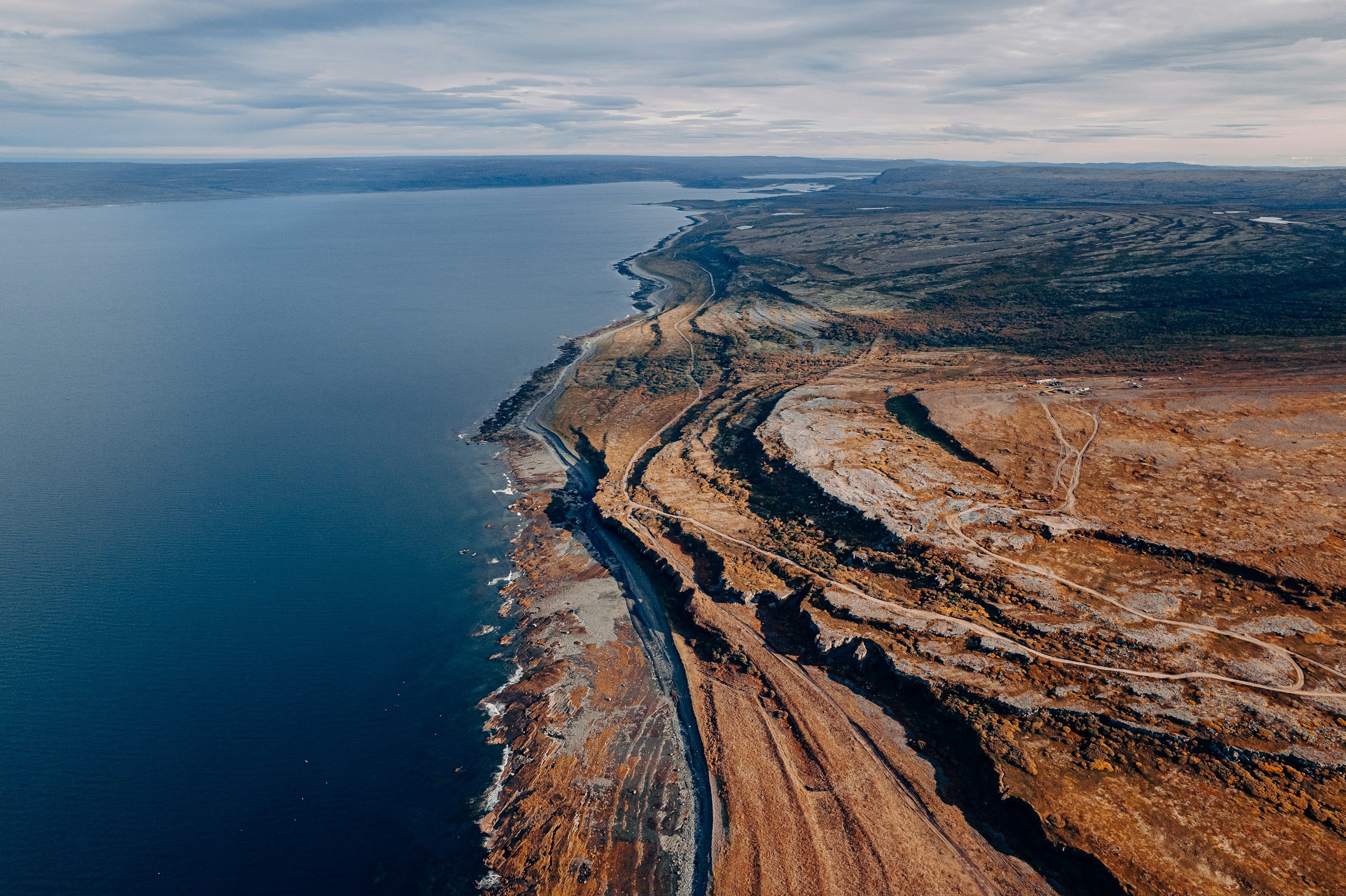
Aerial view of exposed sedimentary and basaltic coastal strata — tectonic uplift meeting the slow erosive force of the sea
Why This Work, Why Now
Because you are not so different from me.
You are intelligent and accomplished and quietly exhausted. You are carrying more than anyone around you fully sees. You are somewhere between the woman you have been and the woman you are becoming — and that in-between place is genuinely, profoundly disorienting, even for someone as capable as you.
You do not need someone to fix you. You are not broken. You are in process.
What you need is someone who can read the terrain you are standing in. Who can hold the vision of who you are becoming when you cannot yet see her clearly. Who can walk beside you with enough rigour and enough warmth to make the journey feel navigable rather than terrifying.
That is what I do.
And that is why, of all the coaches you could find in this space, I might be the one you have been looking for.
What I Bring To This Work
The Geological Perspective
More than twenty years of professional geology have given me something no wellness certification could: a deeply embodied understanding of how complex systems transform. I know, from the inside of a scientific discipline, that the most profound changes do not look like progress while they are happening. I know how to read disruption as information rather than evidence of failure. I know how to navigate uncertainty with rigor and with patience.
These are not metaphors I reach for because they sound interesting. They are the lens through which I genuinely understand the world — including the world of midlife transition.
The Framework
The Elemental Framework™ was developed at the intersection of geological science, evidence-based wellness practice, and a deep, lifelong connection to the intelligence of the natural world. It is built around the five elements — Earth, Water, Air, Fire, and Spirit — and the seasonal transitions that move between them, each representing a different quality of transformation, a different set of signals, and a different set of navigational needs.
It is not a protocol. It is not a prescription. It is a navigational system — one that honors the complexity of what you are moving through and offers orientation rather than instruction.
Every woman I work with moves through the elements differently. There is no fixed sequence, no predetermined pace. The framework meets you where you are and moves with you — which is the only approach that actually works for a process as individual and nonlinear as this one.
The Credentials
I pursued each of the following certifications for my own development — long before I knew I would eventually want to coach. They represent genuine investment in understanding, not resume building.
Certified Wellness Coach — Women's Wellness (CWC)
Certified Nutrition Coach — Precision Nutrition (PN1 NC)
Certified Sleep, Stress Management & Recovery Coach — Precision Nutrition (PN1 SSR)
200-Hour Yoga Teacher Certification
The yoga certification in particular was pursued not to teach classes but to develop a deeper, more embodied understanding of the body's intelligence — its relationship to breath, movement, and the nervous system. That understanding is woven through everything I do with clients.
The Lived Experience
I am not guiding you through terrain I have only studied. I am guiding you through terrain I have inhabited — am inhabiting. The work I do with clients is informed by my own ongoing navigation of midlife transition, conducted from the inside of a demanding professional life, with all of the complexity and constraint that entails.
I know what it is to try to do this work in the margins. I know what it costs to keep performing capability while something fundamental shifts beneath the surface. And I know, from the inside, that it is possible to navigate this without abandoning your professional life, your relationships, or your sense of self.
Because I am doing it.
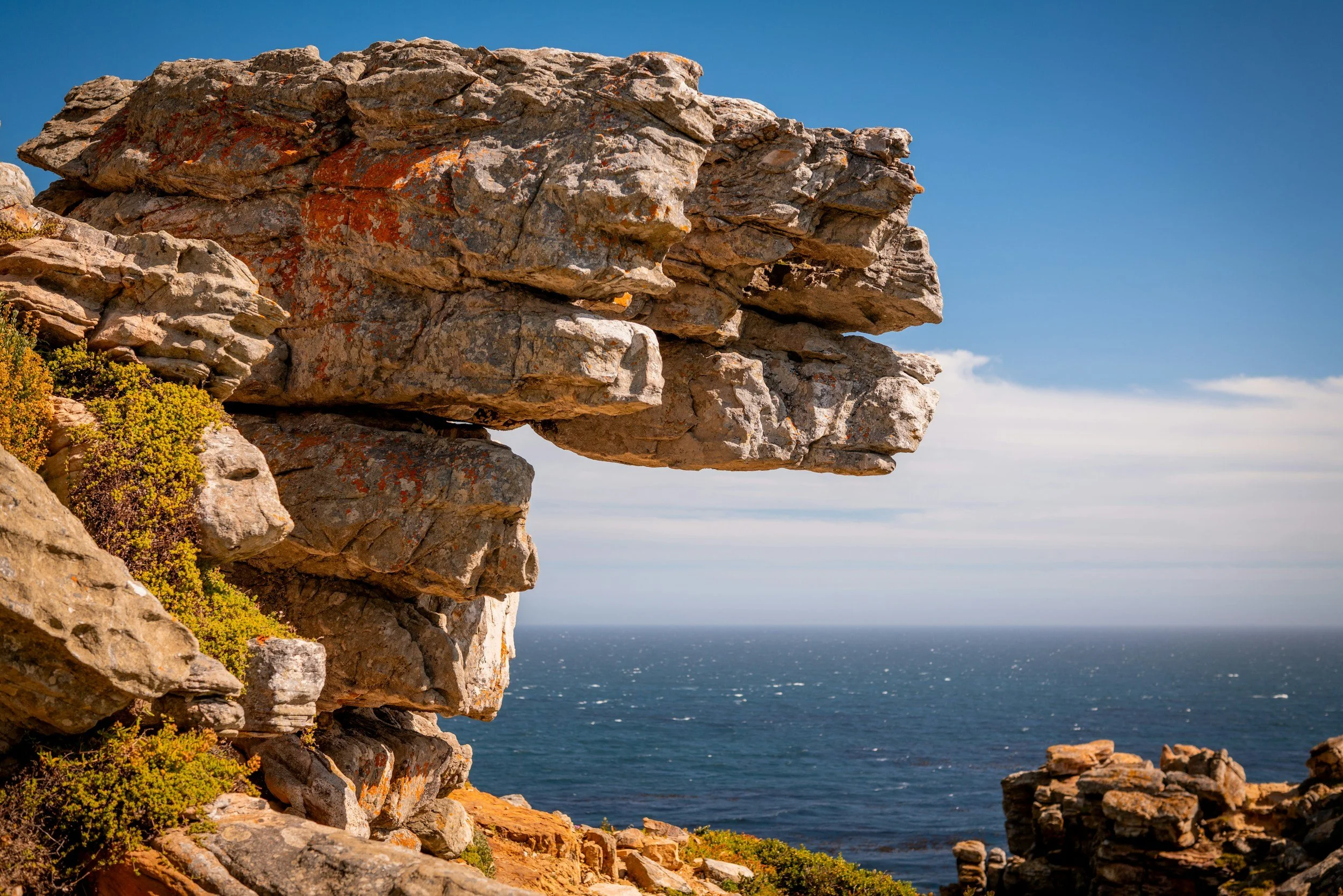
A cantilevered rock formation holding its ground above the sea — the quiet strength of geological balance, earned through sustained pressure and the slow intelligence of natural forces
A Note on Who I Work With
I work with a specific kind of woman, and I want to be honest about that.
She is intelligent and accomplished — often working in technical, analytical, or evidence-based professional environments where intellect is currency and showing vulnerability has historically felt like a liability.
She is in the midst of midlife transition — perimenopause, menopause, or the broader identity reorganization that this stage of life initiates — and she has found that the standard approaches are not touching what actually needs attention.
She is ready. Not almost ready. Not thinking about it. Not waiting until things get a little worse or a little better or a little more convenient. Ready — with the quiet, clear, bodily certainty that it is time to stop managing this and start navigating it.
She does not need to be further along than she is. She does not need to have it together. She needs to be willing — genuinely, seriously willing — to look honestly at where she is and move toward where she could be.
If that is you, I want to work with you.
The Invitation
You have spent a long time being the most capable person in the room.
You are allowed to be the one who needs the guide.
Not because you have failed. Not because you are weak.
Because you are in terrain that requires navigation — and navigation, even for the most experienced traveler, is better with someone who knows the map.
I know this map. I have walked it. I am walking it.
And I would be genuinely honored to walk it with you.
Start with the free guide —
A Geologist's Guide to Reading the Terrain of Midlife Transition