

Lughnasadh | What the Season Actually Made
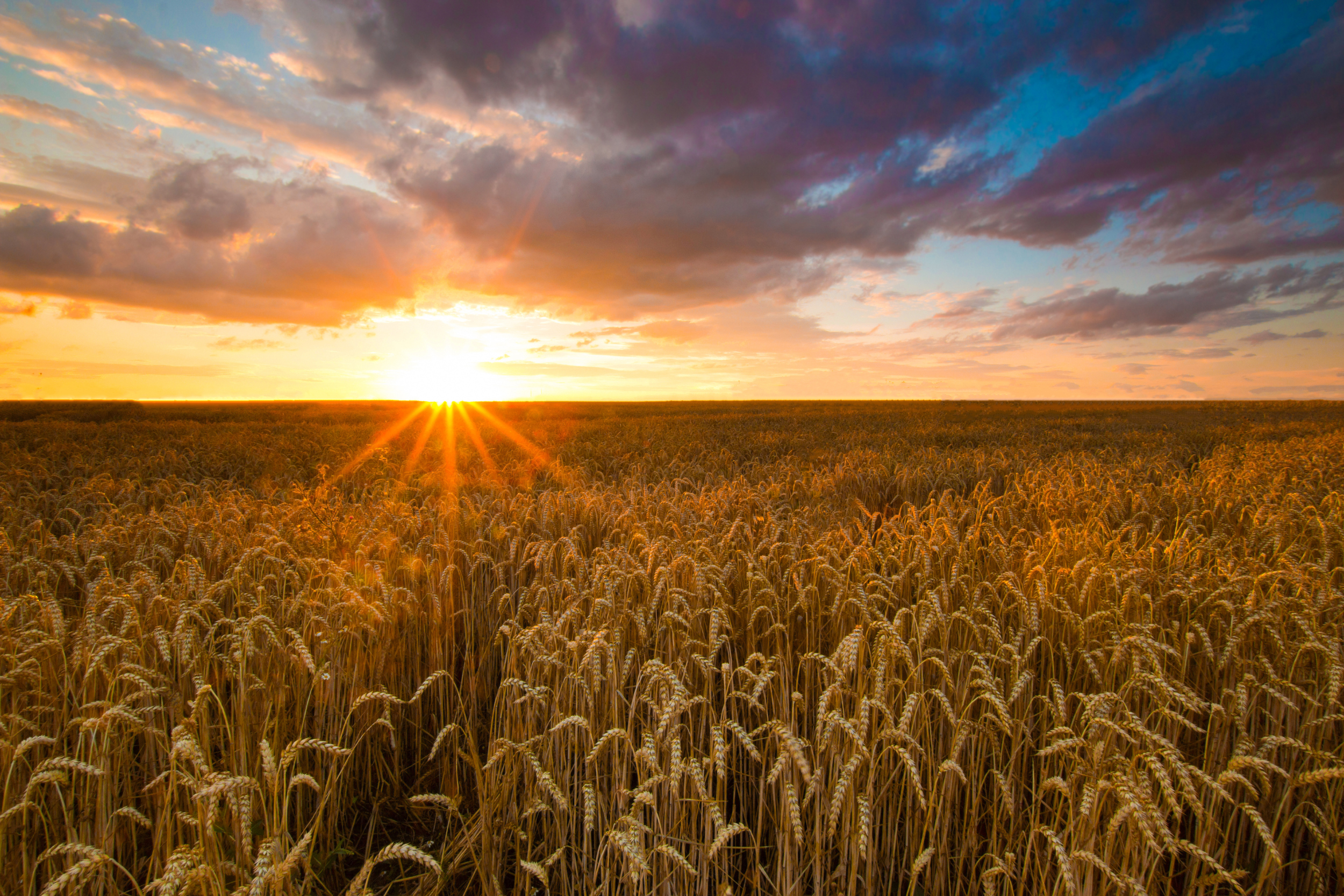
Late summer wheat field.
The season has done what it was going to do.
There is a particular quality to the light in early August. It's still full summer light — long days, the sun high and certain. But the heat has been building since July, when the heaviness first settled in. By the time August arrives, it has reached a different register entirely. The humidity presses down from above or radiates up from the ground depending on where you're standing and what hour it is. Some mornings it meets you at the door before you've taken a full breath. Some afternoons it rises from the pavement in visible waves, the air thick enough to feel like something you move through rather than something you move in.
My body wants to slow down. To conserve. To stop pushing against the density of it and simply go still. I keep going anyway. Because that's what this season asks — not the momentum of June, not the bright acceleration of early summer, but the particular effort of continuing when the conditions are at their most insistent and the visible returns are still catching up to the work.
But I notice this shift in my body before I can name it in the calendar.
A subtle change in the quality of my mornings. Something in me that was oriented toward momentum starts to turn, almost imperceptibly, toward something more like assessment. Not contraction exactly. Inventory.
The agricultural traditions that shaped the Wheel of the Year recognized this moment and named it — Lughnasadh in the older Celtic tradition, Lammas in the Anglo-Saxon one that followed. The first harvest, falling on August 1st, the midpoint between the Summer Solstice and the Autumn Equinox. The grain that was planted in spring, tended through the long summer, is ready to cut. Whatever grew, grew. Whatever didn't, didn't. The season has given its answer.
There is something clarifying about that. And something that requires more honesty than celebration. Because the first harvest is not always the harvest you planned for.
I've been sitting inside that particular honesty this year more than most.
The season asked something significant of me. I built something — this studio, this framework, this space for women in midlife to find language for what they're living. I wrote, and kept writing. I showed up consistently, with intention, in ways I wasn't sure I could sustain. The internal work of this year has been more real than I expected. More generative. More clarifying about who I am and what I'm actually building and why.
And yet. The external evidence has been quiet. The impact I was reaching toward, the visibility I hoped was building — hasn't arrived on the schedule I imagined.
I know this is early. I know the timeline for building something real is longer than a season. I believe that, most days. But standing at the first harvest with a quieter yield than you expected is its own kind of experience. It doesn't feel like failure exactly. It feels more like the gap between what you put into the ground and what has yet to surface.
I don't think I'm alone in this. For women in midlife, this gap has a particular texture. You've been doing the work — the internal work, the invisible work, the kind that doesn't produce evidence anyone else can see. You've changed in ways that are real and hard to articulate. You've built something, or tended something, or let something go that needed to go. And the external landscape hasn't caught up yet. The recognition, the reach, the visible return — still quiet.
This isn't the same as failing. But it isn't comfortable either. And Lughnasadh, more than any other point in the year, is the festival that asks you to be honest about that gap — to stand in it without collapsing it, without inflating it, without looking away.
There is a way of understanding this gap that I keep returning to — one that comes not from wellness culture or productivity frameworks, but from the earth itself. Geologists have a term for what happens when a river in flood moves across a landscape: alluvial deposition. The water carries an enormous load — sediment, mineral material, organic matter — and as it slows and spreads, it lays that material down in layers. From above, in the aftermath, the landscape can look unchanged. The water has moved through. The surface is quiet. But underground, in the substrate, the landscape has shifted. New material has been deposited. The stratigraphy — the readable record of what moved through — has a new layer.
You can't read that layer while it's being laid down. The water is moving too fast, the material too suspended. You can only read it once it has settled, once the flood has passed and you can step back and look at what the season actually left behind.
What I'm learning is that some of the most significant deposition happens invisibly. The layer being laid down isn't always the one you were watching for. The internal growth — the clarifying, the voice-finding, the deepening understanding of what this work actually is — doesn't show up in the metrics. It accumulates the way sediment does: quietly, consistently, in a layer you won't be able to read clearly until you've stepped far enough back.
This is what makes the first harvest hard. You're taking stock before the stratigraphy is fully legible. The season isn't done depositing. But Lughnasadh arrives anyway, and it asks you to look honestly at what you have — not at what you'll eventually be able to read, but at what you can see right now. The visible yield. The invisible one. Both real. Both part of the record.
There is a thread that runs beneath all of this — beneath the inventory, the gap, the honest reckoning with what the season made and what it didn't. In the Elemental Framework™, that thread is Spirit: the connective tissue of the whole system, most present at the moments when the landscape is shifting and something is being asked of you.
The solstices, the equinoxes, the threshold festivals that mark the turning of the year — these are Spirit's territory. These are the moments when the ordinary momentum of living pauses long enough to ask a deeper question.
At the Summer Solstice, Spirit's question was expansive: Who are you becoming in this season of your life? Lughnasadh asks something different. Smaller, in some ways. More specific. What did this season actually make? Not what did you hope it would make. Not what you planned for when you planted. What did it actually make — in you, in your work, in the ground you'll carry forward into the turning that's coming.
That question requires sitting with the full inventory. The visible yield and the invisible one. The growth that shows up in evidence and the growth that shows up only in what you know to be true about yourself now that you didn't know in spring.
Spirit at harvest is not about resolution. It's about recognition. Taking stock of what the season built — including the parts that aren't measurable yet. Including the parts that won't be measurable for a long time.
The first harvest has never been about the perfect yield. The women who brought grain to the altar at Lughnasadh brought what the field gave. Some years that was abundance. Some years it was enough. Some years it was a quiet handful and the knowledge that the underground work — the root systems, the soil structure, the slow microbial labor that no one sees — had been doing something real even when the surface was still.
They didn't resolve the gap. They stood in it, acknowledged what the season had given, and trusted that the deposit was there even when they couldn't yet read it.
That trust isn't passive. It isn't the same as pretending the yield is more than it is, or deciding that what didn't grow doesn't matter. It's a more active thing than that — the decision to take honest stock, to hold both the visible and invisible harvest without letting either one cancel the other out.
Autumn is coming. The next season will ask its own things of you — Earth's season, the time for grounding what was built and releasing what didn't take root. But that work belongs to September. Right now, at this threshold, the invitation is simpler and harder than what comes next.
Look at what the season made. All of it. The growth you can point to and the growth you can only feel. The yield that arrived on schedule and the deposit that's still settling. Take honest stock. Then carry it forward.
The field's answer is always more complete than it first appears.
If you want company for this kind of inventory — someone alongside you as the seasons turn — Elemental Current is the place. Twice-monthly field notes on the framework, the seasons, and the terrain of midlife. The close reading that honest stock-taking depends on.
The Elemental Assessment is coming soon — a personalized starting point for understanding how each of the five elements is showing up in your life right now. Not a diagnosis. A map.
Remember: this post is for informational purposes only and may not be the best fit for you and your personal situation. It shall not be construed as medical advice. The information and education provided here is not intended or implied to supplement or replace professional medical treatment, advice, and/or diagnosis. Always check with your own physician or medical professional before trying or implementing any information read here.
